

James Mimlitz @ SCADAmetrics – ‘Slim’
The purpose of this article is to introduce a new noise filtering device and the practical implementation techniques that will suppress the unwanted effects of EMI (Electromagnetic Interference) upon transducers, level sensors, flow meters and other low-voltage electronic instrumentation in general.
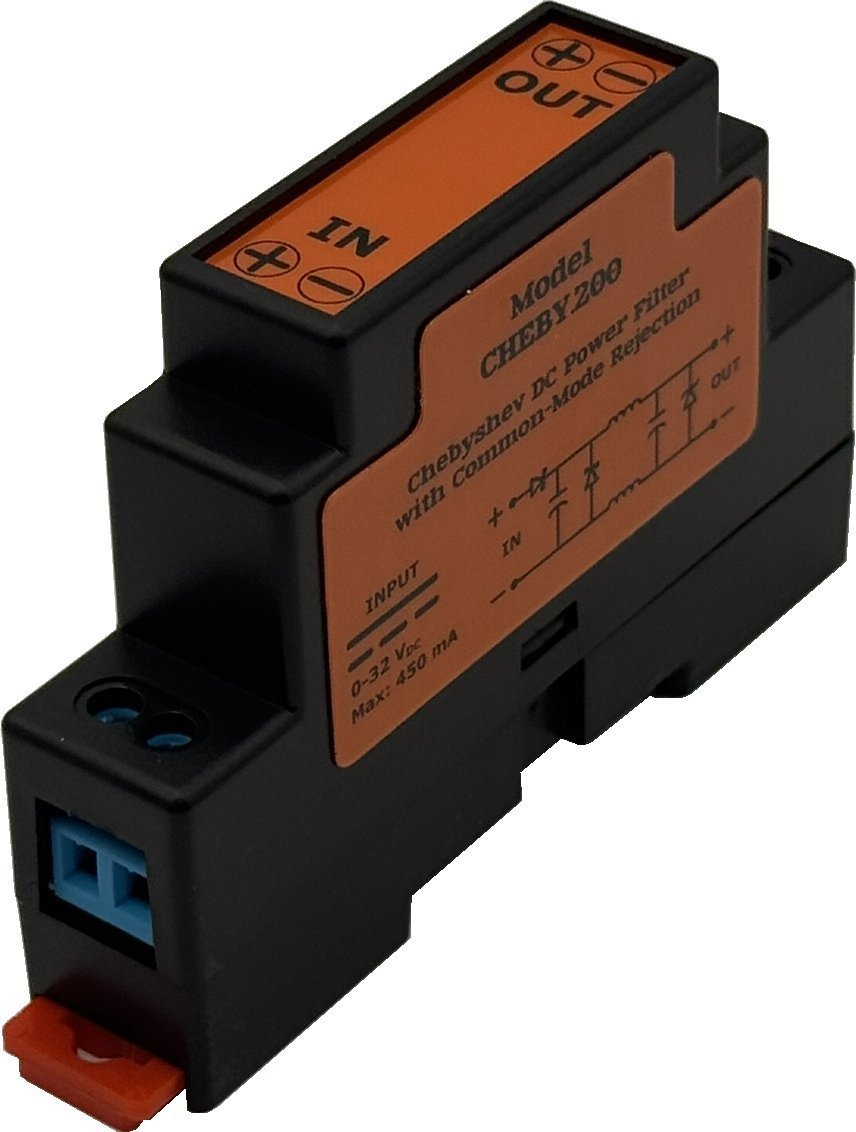
The CHEBY.200 — a compact, passive, DIN-rail-mountable, noise-attenuation instrument — is designed to be installed on the power-side of DC-powered, low-voltage instruments and controllers and/or slowly-changing 2-wire analog signals, such as 4-20 milliamp pressure and flow sensors. The CHEBY.200 is not suitable for fast-changing 2-wire signals, such as RS.485 and modem lines, as the lowpass filter will distort the waveform.
Background…
In the absence of proximal EMI (Electro-Magnetic Interference) noise sources, trouble-free telemetry and SCADA instrumentation is generally achieved easily. However, it is the rare remote infrastructure station that does not contain a multitude of EMI noise generating equipment. Typical examples of EMI sources include VFD’s (Variable Frequency Drives), Electric Motors, Chlorine Generators, Compressors, Telemetry & Cellular Modems, Welders, et cetera.
When mains-powered instrumentation is combined with extended signal cable distance, effects from stray capacitance and common-mode interference can creep in — magnifying the effects of EMI noise and thereby leading to measurement errors and/or communication breakdown.
Ideal, EMI-Free Environment
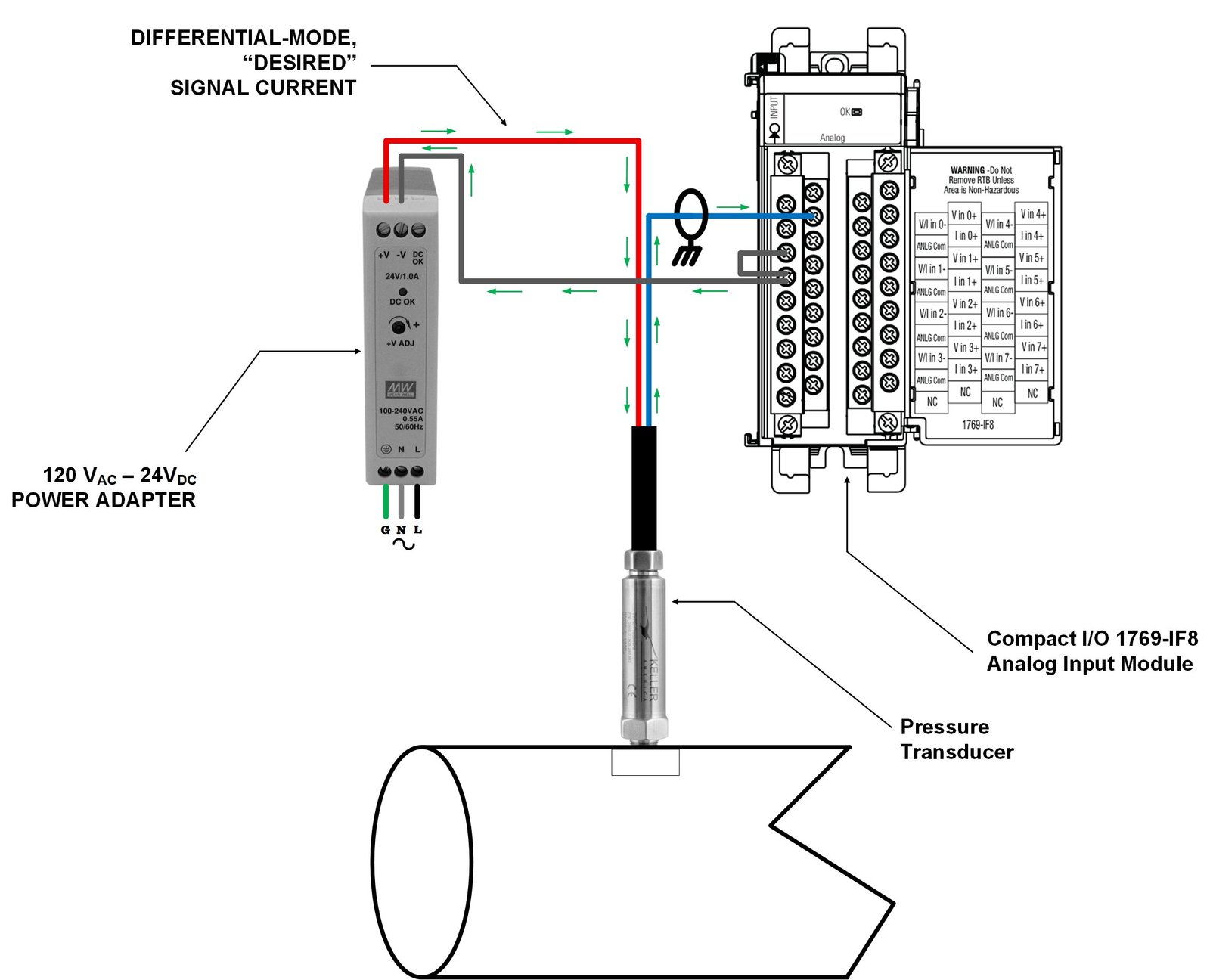
The following diagram illustrates a 4-20mA pressure transducer installed within an ideal, EMI-free environment. In this example, an Allen-Bradley 1769-IF8 Compact I/O Module is shown as the Analog Input Module, although the concepts apply to any make & model PLC or controller. The circuit includes only the desired, differential-mode signal currents:
Adverse Effects of Common-Mode Interference Upon Instrumentation
The following diagram illustrates how undesirable common-mode currents can be generated by a proximal noise source (e.g. VFD) and superimposed upon a (desired) differential-mode 2-wire 4-20 milliamp signal. Common-mode currents can interfere with the operation of the transducer, the connected PLC, or both. Note the in-phase characteristic of the common-mode currents:

Attenuation of Common-Mode Interference with a Chebyshev Low-Pass Filter
The following illustration demonstrates one example of how a SCADAmetrics model CHEBY.200 Chebyshev Filter can be utilized to suppress the undesirable common-mode currents, while preserving the desirable differential-mode currents. When particularly strong EMI is present, two (or more) CHEBY.200 Filters may be installed in series.

When To Consider Using a CHEBY.200 Filter?
Common-Mode Noise Interference should be suspected if an instrument operates correctly in isolated, battery-powered mode — but behaves erratically when connected to mains-power.
Customers have reported that the installation of one (or more) SCADAmetrics Model CHEBY.200 DC Power & Signal Filter for Low-Voltage Devices has provided effective suppression of VFD-induced signal anomalies.
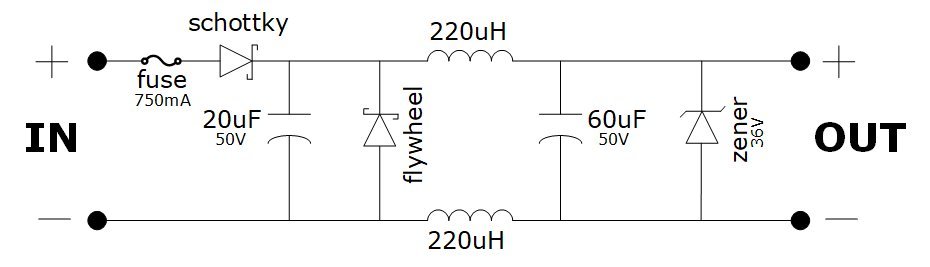
The following schematic details the internal Chebyshev Filter of the model CHEBY.200. Note the presence of significant series inductance on both the positive and negative legs of the circuit. This ensures that high-frequency, common-mode currents are met with increasing impedance at higher frequencies. The flywheel Schottky diode and a 36V unidirectional zener diode absorb voltage spikes due to any abrupt disconnection of the connected external circuit. The CHEBY.200 datasheet is available: HERE
Questions?…
Are you interested in learning more about how SCADAmetrics flow instrumentation, when implemented with good signal filtering and wiring practices, can provide reliable and accurate signaling to your SCADA, Telemetry, or Building Automation System? Give us a call!… We’ll be glad to discuss the details!